SP-009-007 Scoring Systems Catalog
This document is a draft version.
Severity assessment
- Local Scoring Systems: These systems are designed to assess the severity of skin conditions based on images captured from a single body site. They provide a localized evaluation of the condition, allowing for targeted treatment and management.
- Global Scoring Systems: These systems are intended for conditions that affect multiple body sites.
Local Scoring Systems Catalog Summary
| Scoring System | Name | Local (1 image) | Global (If score involves many body sites) | Questionnaire | Calculator Available |
|---|---|---|---|---|---|
| aladin | Acne lesion estimation grading index | Yes | - | No | On request |
| aihs4 | Local automatic international hidradenitis suppurativa severity score system | Yes | - | No | On request |
| apasi | Local automatic psoriasis area and severity index | Yes | On request or Managed by the integrator | Yes | https://pasi.legit.health/ |
| ascorad | Local automatic scoring of atopic dermatitis | Yes | On request or Managed by the integrator | Yes | https://scorad.legit.health/ |
| aeasi | Eczema Area and Severity Index | Yes | On request or Managed by the integrator | Yes | On request |
| auas | Local automatic urticaria activity score over | Yes | - | Yes | https://uas.legit.health/ |
| agppga | Generalized Pustular Psoriasis Physician Global Assessment | Yes | - | No | https://gppga.legit.health/ |
| asalt | Automatic Severity of ALopecia Tool | Yes | On request or Managed by the integrator | No | https://salt.legit.health |
| avasi | Vitiligo Area Scoring Index | Yes | Yes | No | On request |
| awosi | Automatic WOund Severity Index | Yes | - | No | https://awosi.legit.health/ |
Within each calculator, you can find detailed information about the scoring system, including how the score is calculated, the specific questions involved, and other relevant details to help you better understand and use the assessment tool.
Global Scoring Systems Catalog Summary
| Scoring System | Name | Global (If score involves many body sites) | Questionnaire | Calculator Available | Number of Required Images | Body Sites Involved |
|---|---|---|---|---|---|---|
| ascorad | Local automatic scoring of atopic dermatitis | Managed by the integrator or On request (WIP) | Yes | On request | 5 images | (*) |
| apasi | Local automatic psoriasis area and severity index | Managed by the integrator or On request (WIP) | Yes | On request | 8 images | (*) |
| aeasi | Eczema Area and Severity Index | Managed by the integrator or On request (WIP) | Yes | On request | 8 | (*) |
| avasi | Vitiligo Area Scoring Index | Yes | No | On request | 8 ∫ | (*) |
| asalt | Automatic Severity of ALopecia Tool | Managed by the integrator or On request (WIP) | No | https://salt.legit.health | 4 images | headFront, headTop, headLeft, headRight |
Image Capture Perspectives Involved for Global Scoring Systems
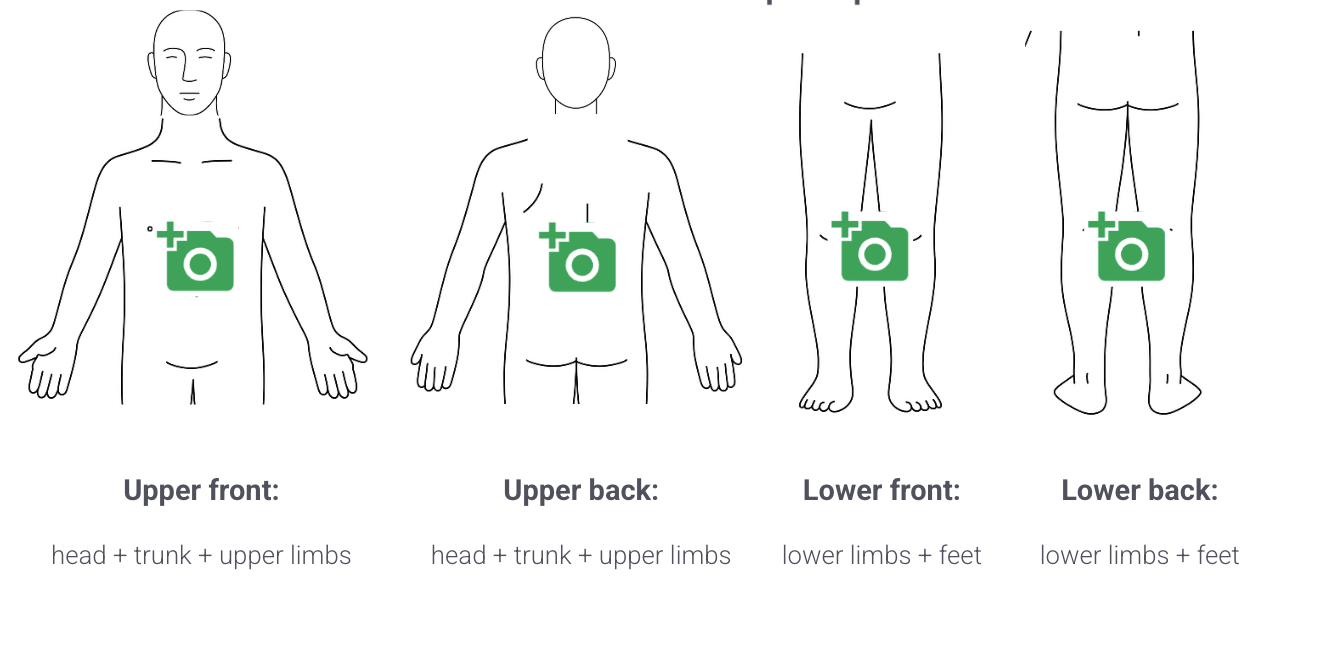
- Upper front: head (includes neck) + trunk + upper limbs.
- Upper back: head (includes neck) + trunk + upper limbs.
- Lower front: lower limbs + feet
- Lower body (2): lower limbs + feet
Note: Ensure complete body parts like hands, feet, head, and waist are visible. You can capture more body area than required in the picture, as the algorithm will only consider the corresponding area
AEASI Global and APASI Global image capture required images
The severity may be measured using the data from 8 images. Each images captures a specific perspetive of the body.
Example for Psoriasis: The following image shows the 8 perspectives and how they are related to measuring the involvement of the Body Surface Area (BSA) in psoriasis.
Body Surface Area (BSA) 4 perspectives
Representative body area lesion close ups
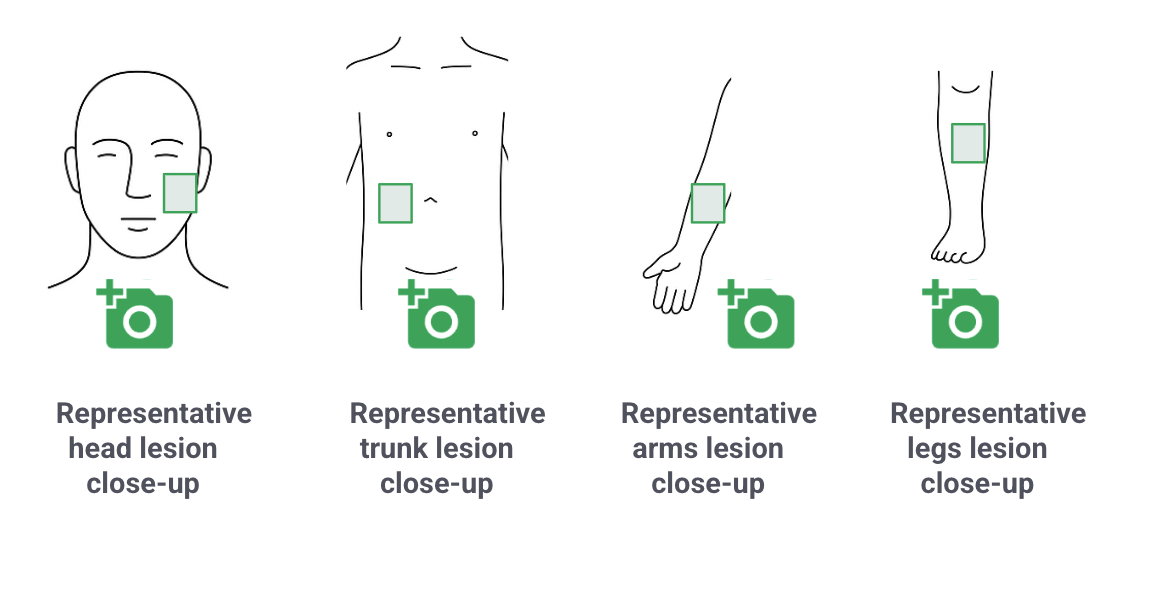
8 images per visit: 4 predefined perspectives and 4 representative close-up images of the lesion in predefined areas
ASCORAD Global image capture required images
The severity may be measured using the data from 8 images. Each images captures a specific perspetive of the body.
Example for Psoriasis: The following image shows the 8 perspectives and how they are related to measuring the involvement of the Body Surface Area (BSA) in psoriasis.
Body Surface Area (BSA) 4 perspectives
1 Representative lesion close up image
Click on the buttons to open the camera or to upload a file.
Representative lesion close up
5 / 5
5 images per visit: 4 predefined perspectives and 1 representative close-up image of the lesion in predefined areas
Scoring Systems Catalog Details
| Scoring System | Name | Local (1 image) | Global (If score involves many body sites) | Questionnaire | Number of Questionnaire Questions | Questions Content |
|---|---|---|---|---|---|---|
| aladin | Acne lesion estimation grading index | Yes | - | No | 0 | - |
| aihs4 | Local automatic international hidradenitis suppurativa severity score system | Yes | - | No | 0 | - |
| apasi | Local automatic psoriasis area and severity index | Yes | On request or Managed by the integrator | Yes | 1 | Affected area (*) (Response options: number from 0 to 100) |
| ascorad | Local automatic scoring of atopic dermatitis | Yes | On request or Managed by the integrator | Yes | 3 | Affected area (*) (Response options: number from 0 to 100) Itchiness (Response options: Select from 0 to 10) Sleeplessness (Response options: Select from 0 to 10) |
| aeasi | Eczema Area and Severity Index | Yes | On request or Managed by the integrator | Yes | 2 | Affected area (*) (Response options: number from 0 to 100) Patient age (Response options: number from 0 to 100) |
| auas | Local automatic urticaria activity score over | Yes | - | Yes | 1 | Itchiness (Response options: Select from 0 to 3) |
| agppga | Generalized Pustular Psoriasis Physician Global Assessment | Yes | - | No | 0 | - |
| asalt | Automatic Severity of ALopecia Tool | Yes | On request or Managed by the integrator | No | 0 | - |
| avasi | Vitiligo Area Scoring Index | Yes | Yes | No | 0 | - |
| awosi | Automatic WOund Severity Index | Yes | - | No | 0 | - |
(*) The questionnaire item "Affected area" applies primarily to local scoring systems and may be omitted in global scoring systems depending on the method of image capture.
APASI: Automatic Psoriasis Area and Severity Index
The Psoriasis Area and Severity Index (PASI) is a widely used method for measuring the severity of psoriasis. The score is calculated by evaluating clinical signs and the affected area across four body regions.
PASI Formula
The PASI score is calculated by assessing four body regions and summing their weighted scores. For each region, the calculation involves:
- Summing the Intensity Scores: The scores for Erythema (E), Induration (I), and Scaling (S) are added together.
- Multiplying by Area Score: The resulting sum is multiplied by the score for the affected area (A).
- Applying the Body Site Weight: The result is multiplied by the fixed weight for that body region (e.g., 0.1 for the head, 0.3 for the trunk).
PASI = 0.1 (Eh + Ih + Sh) Ah + 0.2 (Eu + Iu + Su) Au + 0.3 (Et + It + St) At + 0.4 (El + Il + Sl) Al
1. Body Site Contribution
The body is divided into four regions, each contributing a specific percentage to the total score.
| Region | Abbreviation | Weight |
|---|---|---|
| Head | h | 10% |
| Upper Extremities | u | 20% |
| Trunk | t | 30% |
| Lower Extremities | l | 40% |
2. Clinical Signs Assessment (E, I, S)
Three clinical signs are assessed for each body region on a 5-point scale.
| Clinical Sign | None | Mild | Moderate | Severe | Very Severe |
|---|---|---|---|---|---|
| Erythema/redness | 0 | 1 | 2 | 3 | 4 |
| Induration/thickness | 0 | 1 | 2 | 3 | 4 |
| Desquamation/scaling | 0 | 1 | 2 | 3 | 4 |
3. Area of Involvement (A)
The percentage of the affected area is also scored for each region, but the scoring system for the area is different from the clinical signs.
It is crucial to distinguish between two different percentages used in the PASI calculation:
-
Affected Area (A): This represents the percentage of skin affected by psoriasis within a specific body region. For example, if half of the trunk is covered in lesions, the affected area for the trunk is 50%. This value is used to calculate the subscore for that region.
-
Body Site Weight: This is a fixed percentage that represents the contribution of the entire body region to the final Global PASI score. For example, the trunk always accounts for 30% of the total score, regardless of how much of it is affected.
In simple terms: Affected Area measures the extent of the condition on a body part, while Body Site Weight determines the importance of that body part in the overall score.
Local vs. Global PASI
- A Local PASI score is the calculated PASI for a single body site (e.g., just the head). It represents that site's contribution to the total score. In the main formula, this means the scores for all other body sites are set to 0.
- A Global PASI score is the final score, combining the weighted scores from all four body regions for a complete assessment.
Global PASI Calculation Example
This diagram illustrates how the scores from each body region are calculated and then summed to produce the final Global PASI score.
aSCORAD: Automatic Scoring of Atopic Dermatitis
The aSCORAD (Automatic Scoring of Atopic Dermatitis) is a widely used method for assessing the severity of atopic dermatitis. The score is calculated from three components: the extent of the affected area, the intensity of clinical signs, and subjective symptoms reported by the patient.
aSCORAD Formula
The final score is calculated by combining three key components:
- Component A (Extent): The percentage of affected body surface area (0-100) is divided by 5.
- Component B (Intensity): The sum of scores for six clinical signs (0-18) is multiplied by 3.5 (or 7/2).
- Component C (Subjective Symptoms): The sum of scores for itch and sleeplessness (0-20) is added directly.
aSCORAD = A/5 + 7B/2 + C
Component A: Extent Score (0-100)
This component measures the percentage of the body surface area affected by atopic dermatitis, calculated using the "Rule of Nines".
| Body Region | Adult (%) | Child (%) | Infant (%) |
|---|---|---|---|
| Head and Neck | 9 | 15 | 18 |
| Trunk (Front/Back) | 18 / 18 | 16 / 16 | 18 / 18 |
| Upper Extremities | 9 x 2 | 9 x 2 | 9 x 2 |
| Lower Extremities | 18 x 2 | 16 x 2 | 13 x 2 |
| Genitals | 1 | 1 | 1 |
| Total | 100 | 100 | 100 |
Component B: Intensity Score (0-18)
This component assesses the average intensity of six clinical signs across the affected areas. The final score is the sum of the scores for each sign.
| Clinical Sign | None | Mild | Moderate | Severe |
|---|---|---|---|---|
| Erythema/redness | 0 | 1 | 2 | 3 |
| Edema/papulation | 0 | 1 | 2 | 3 |
| Oozing/crusting | 0 | 1 | 2 | 3 |
| Excoriation | 0 | 1 | 2 | 3 |
| Lichenification | 0 | 1 | 2 | 3 |
| Dryness | 0 | 1 | 2 | 3 |
Component C: Subjective Symptoms Score (0-20)
This component is based on the patient's self-assessment over the last three days, using a visual analogue scale (VAS) from 0 to 10.
| Symptom | Description | Scale |
|---|---|---|
| Pruritus | Average itch intensity | 0 - 10 |
| Sleeplessness | Difficulty sleeping due to skin condition | 0 - 10 |
The final subjective score is the sum of the scores for both symptoms (max. 20).
aSCORAD Calculation Examples
Local vs. Global aSCORAD
- A Local aSCORAD score assesses severity within a single body region. For this calculation, Component A (Extent) and Component B (Intensity) are determined only from the specified area, assuming all other body regions have a score of 0. Component C (Subjective Symptoms) remains a global measure.
- A Global aSCORAD score provides a complete assessment by calculating Component A and B based on the condition across the entire body.
Global aSCORAD Calculation example
This diagram shows how the three components are combined to calculate the final Global aSCORAD score.
Local aSCORAD Calculation example
This diagram illustrates the calculation for a single lesion covering 10% of one arm.
The resulting Local aSCORAD for the arm lesion is 37.18.
aEASI: Automatic Eczema Area and Severity Index
The aEASI (Automatic Eczema Area and Severity Index) is a scoring system used to measure the severity and extent of eczema. The score is calculated by assessing four clinical signs and the affected area across four body regions, with different multipliers for adults and children.
aEASI Formula
The final score is the sum of the individual scores from the four body regions. Each regional score is calculated by multiplying the sum of its severity scores by its area score and the corresponding weight.
Regional Score = (Erythema + Edema/Papulation + Excoriation + Lichenification) _ Area Score _ Weight
aEASI Score = Sum of all 4 Regional Scores
1. Severity Score (0-3)
Each of the four clinical signs is graded on a 4-point scale.
| Score | Severity |
|---|---|
| 0 | Clear / None |
| 1 | Mild |
| 2 | Moderate |
| 3 | Severe |
2. Area Score (0-6)
The percentage of involvement within each body region is converted to an area score.
| % Involvement | Area Score |
|---|---|
| 0 | 0 |
| 1-9% | 1 |
| 10-29% | 2 |
| 30-49% | 3 |
| 50-69% | 4 |
| 70-89% | 5 |
| 90-100% | 6 |
3. Body Region Weights
The weights differ between adults and children under 8 years old.
| Body Region | Adults | Pediatrics (< 8 years old) |
|---|---|---|
| Head/Neck | 0.1 | 0.2 |
| Trunk | 0.3 | 0.3 |
| Upper Extremities | 0.2 | 0.2 |
| Lower Extremities | 0.4 | 0.3 |
aEASI Calculation Examples
Global aEASI Calculation
This diagram shows a sample calculation for an adult patient's global score.
Local aEASI Calculation
This diagram shows a sample calculation for a local score focusing only on the Upper Extremities, broken down into its components.
EASI Score Interpretation
| Score Range | Interpretation |
|---|---|
| 0 | ⚪️ Clear |
| 0.1-1.0 | 🟢 Almost Clear |
| 1.1-7.0 | 🟢 Mild |
| 7.1-21.0 | 🟡 Moderate |
| 21.1-50.0 | 🟠 Severe |
| 50.1-72.0 | 🔴 Very Severe |
How can customers consume this service?
There are many ways for customers to consume the different scoring systems, ranging from simple JSON APIs and web apps to ready-made calculators and specialized tools for clinical trials, ensuring flexibility to meet diverse needs.
Last updated: 2025-10-28 ㅤㅤ ㅤ